Start here: Watch How to Save on Your Electric Bill for a short overview of how to read your bill, use less electricity, and choose your next steps.
Understand your electric bill Learn what you pay for, how much electricity you use, and how supply choices affect your bill.
Your electric bill shows how much electricity you use, who supplies your electricity, and which charges remain even if you reduce usage or add solar.
| Resource | What you'll find |
|---|---|
| Understand Your Bill | Learn the difference between supply, delivery, customer charges, and usage charges. |
| Budget Billing | The utility Budget Billing evens out your energy costs by dividing your annual electric usage into 12 level monthly payments. |
| Electric Suppliers | Compare available electric supply offers. |
| Rye Community Power | RCP customer portal. Enroll or switch to renewable energy options. |
Your Annual Use How to calculate your annual electric use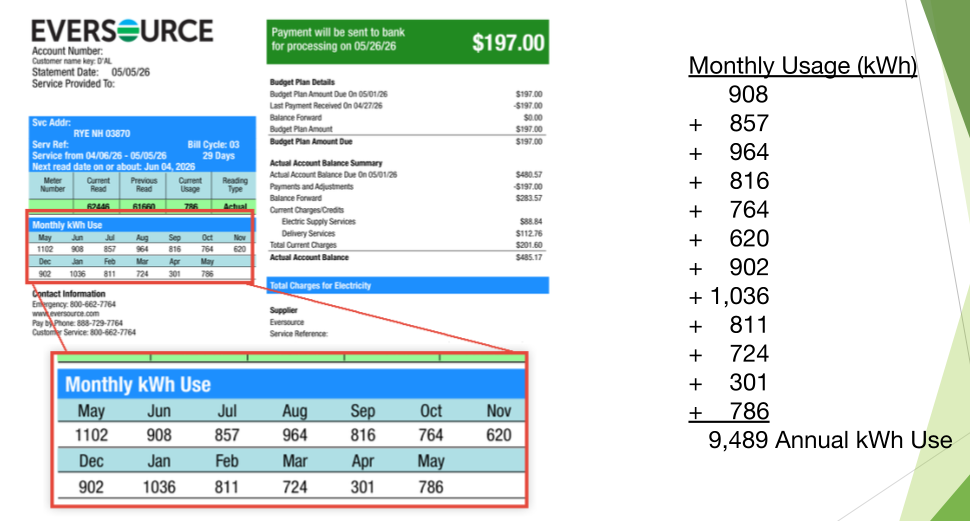
This table is on the second page of your Eversource bill. It shows the Monthly kWh Use for the last 13 months. The sum of the last 12 months of kWh use equals your annual electric use. Your annual use is needed if you want to request an estimate for a solar system. |
|
Reduce energy use and cost Start with simple steps, then explore local efficiency program audits, weatherization, and rebates.
Reducing energy use lowers your bills before you make larger upgrades. Start with do-it-yourself steps, then consider an energy audit, weatherization, and appliance rebates.
| Resource | What you'll find |
|---|---|
| NHSaves | Find energy-saving programs and rebates. |
| Home Energy Performance Program | Check your eligibility for a home energy audit through the Home Energy Performance program |
| Button Up Workshops | View upcoming in-person Button Up workshops and learn how to save energy. |
| Recorded Button Up Workshop | Watch a recorded Button Up presentation. |
Heating Fuel Prices Compare New Hampshire’s average heating fuel prices and prices listed by individual suppliers. |
|
Explore solar and batteries Learn the basics, estimate costs, compare payment options, and decide whether solar or battery storage fits your home.
Solar can offset some or most of the electricity you buy from the grid, lowering your electric bill and reducing your exposure to future electric-rate increases. A solar system can also earn ongoing income from the sale of Renewable Energy Credits (RECs). Battery storage is mainly for backup power, and eligible batteries may also earn annual payments through Eversource ConnectedSolutions.
| Resource | What you'll find | |||||||||||||||||||||||||||||||||||||||||||||||||||||||||||||||||||||||||||
|---|---|---|---|---|---|---|---|---|---|---|---|---|---|---|---|---|---|---|---|---|---|---|---|---|---|---|---|---|---|---|---|---|---|---|---|---|---|---|---|---|---|---|---|---|---|---|---|---|---|---|---|---|---|---|---|---|---|---|---|---|---|---|---|---|---|---|---|---|---|---|---|---|---|---|---|---|
Rooftop Solar Basics Watch a short introduction to rooftop solar for homes.View a short video about rooftop solar basics. Rooftop Solar for Homes |
||||||||||||||||||||||||||||||||||||||||||||||||||||||||||||||||||||||||||||
Solar Estimator Estimate system size, cost, payments, and potential savings, or request installer estimates.Estimate system size, cost, monthly payment, and potential savings for your roof. Estimator privacy: You can use the estimator without providing your name, email address, or phone number. If you request installer estimates, your email address is stored for 90 days only to forward installer replies and record whether an installer responded. Participating installers do not receive your email address. The tracking sheet does not store your street address, electric use, roof answers, request form, or installer proposals. Request and reply emails pass through the program Gmail account and follow that mailbox's normal retention settings. Participating installers have agreed to provide a preliminary estimate based on the basic information you provide. They have agreed to a no solicitation policy. If you request an estimate, the estimator tool sends a separate email to each participating installer with a fillable form attached. Installers reply to that request email, and their replies and attachments are forwarded automatically to you. Use this tool to create a rough rooftop solar estimate and to request estimates from installers. |
||||||||||||||||||||||||||||||||||||||||||||||||||||||||||||||||||||||||||||
How to Pay for Solar Compare cash, loan, lease, and prepaid lease options for an ideal benchmark town solar system.This chart compares several ways to pay for a rooftop solar system sized to offset the average local home's annual electricity use. These examples are for illustration only and are not quotes or guarantees. Use them as a reference when comparing payment options and reviewing preliminary estimates for your own home.
This opens a print-ready page. Choose “Save as PDF” or “Microsoft Print to PDF” in the print dialog.
Illustrative full-offset scenario: assumes no remaining variable utility bill; actual net-metering charges may differ. average local annual use of 8,848 kWh; south-facing roof; minimal shade; roof less than 10 years old; no roof or structural work, battery, or electric service upgrade included.
Ownership horizon matters. If you may move within about 10 years, compare the 10-year costs as well as the long-term costs. Compare remaining loan or lease obligations and confirm transfer or payoff terms before assuming that financing is better for a shorter ownership period.
Benchmark assumptionsSystem size7.48 kW DC
Panels17 × 440 W
Price per watt$2.85/W
Cash price$21,318
Estimated electric bill$210/mo
How the payment comparison worksEstimated electric bill equals annual kWh × rate ÷ 12, plus the utility customer charge. A useful first comparison is whether the monthly solar payment, plus any remaining utility charges, is lower than the estimated monthly electric bill without solar. Estimated solar monthly cost includes the loan or lease payment, if any, plus the utility customer charge. These are illustrative financing scenarios. Dated provider quotes and buyout terms have not yet been verified. Actual rates, payments, buyout terms, ownership provisions, maintenance responsibilities, and transfer requirements vary by lender, financing provider, installer, project size, and homeowner qualifications. The local energy committee does not recommend, endorse, or receive compensation from any lender, financing provider or installer. Homeowners should obtain and compare proposals from multiple installers and financing providers.
The introduction and homeowner estimate show savings including RECs. This table shows payments and savings excluding RECs so different ownership arrangements can be compared. Full-offset billing and unchanged rates over the comparison period are illustrative assumptions. Calculation workbook and dated source review Important: Ten-year figures are payments made, not ownership cost or the amount needed to exit a contract. The prepaid figure includes the $1,000 year-five buyout, paid separately in cash. Loan balances and later contractual payments are shown separately; do not add both remaining principal and remaining scheduled payments. The 25-year comparison period is shown for reference only. Confirm all loan, lease, buyout, sale-transfer, ownership, escalation, and maintenance terms in writing. Utility customer-charge increases are not factored into these estimates. All values are illustrative and may change based on site conditions and lender terms. |
||||||||||||||||||||||||||||||||||||||||||||||||||||||||||||||||||||||||||||
How to Decide Review price, timing, warranties, service, reputation, and other factors before choosing.Price is only one factor when choosing an installer. Estimated savings matter, but they should not be the only factor in choosing a solar installer or payment option. Also consider when the installation can happen, how long the project is expected to take, the installer’s reputation, the clarity of the proposal, warranty terms, service and maintenance support, whether the installer has local experience, and whether the company is likely to be around years from now if service is needed. A lower price is helpful only if the system is well designed, installed properly, and supported over time. Ask a neighbor who already has solar about their experience. |
||||||||||||||||||||||||||||||||||||||||||||||||||||||||||||||||||||||||||||
Solar Neighbors Ask a Rye homeowner about their experience owning solar.There are currently over 180 solar homeowners in Rye. Some have volunteered to answer residents' questions about their experience owning solar. Send your question to the Energy Committee. We will forward it to one of the volunteers. |
||||||||||||||||||||||||||||||||||||||||||||||||||||||||||||||||||||||||||||
Net Metering Learn how excess solar generation can be credited toward future electric bills.Net Metering explains how excess solar generation is credited toward future electric bills. Rye Community Power currently cannot offer net-metering credits because Eversource does not provide the usage data needed to calculate them. This is an Eversource data limitation, not a Rye Community Power policy. For now, homeowners who want credit for excess solar generation must use Eversource as their electricity supplier. |
||||||||||||||||||||||||||||||||||||||||||||||||||||||||||||||||||||||||||||
Renewable Energy Credits Learn how a solar system earns renewable energy credits that may be sold.A solar system generates renewable energy credits that you can sell to earn extra income. There are several places to sell them, but Rye's electric supplier, CPCNH, offers a REC aggregation program. Prices and eligibility need confirmation. Learn more at Sell Solar Credits (RECs). |
||||||||||||||||||||||||||||||||||||||||||||||||||||||||||||||||||||||||||||
Plug-in Solar Understand small plug-in systems and when New Hampshire's new law takes effect.Plug-in solar is a small, movable solar-electric system designed to offset some electricity used at the home and connect through a receptacle or other non-permanent wiring. New Hampshire's 2026 law allows one compliant system per metered customer, with a maximum inverter output of 1,200 watts AC, without utility preapproval or an interconnection fee. The law's general provisions do not take effect until January 1, 2027; its building-code provision takes effect separately after the state is notified that a nationally recognized safety standard exists. |
||||||||||||||||||||||||||||||||||||||||||||||||||||||||||||||||||||||||||||
Batteries Explore backup power and utility incentives for eligible battery systems.Battery incentives may let eligible batteries provide backup power and earn ongoing annual payments through the utility's ConnectedSolutions program. |
||||||||||||||||||||||||||||||||||||||||||||||||||||||||||||||||||||||||||||
The local energy committee does not receive compensation, endorse any installer, certify pricing, recommend financing, or guarantee savings. Its role is to help residents understand their options with reliable information. Homeowners should review proposals carefully before making a decision.
Questions? Contact the local energy committee at the committee email.